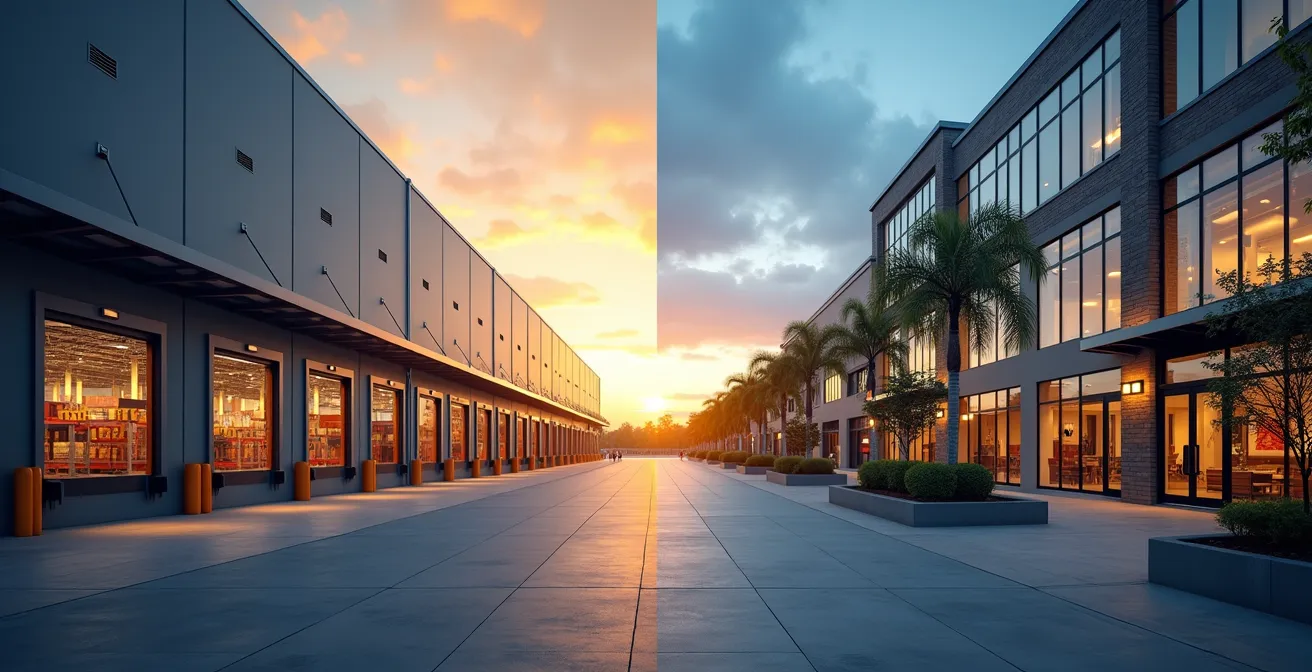
The debate over industrial vs. retail for recessionary stability misses the point: true resilience is found at the asset level, not the sector level.
- Niche sectors like last-mile logistics and data centers offer high-demand profiles but come with unique barriers to entry and risks that require specialized underwriting.
- Tenant creditworthiness, lease structure, and the mission-critical nature of an asset are more critical predictors of stability than its overarching sector classification.
Recommendation: Focus on granular, asset-level underwriting and a disciplined capital rotation strategy rather than making broad bets on entire property sectors.
For investors seeking to reallocate capital toward defensive assets, the commercial real estate (CRE) landscape presents a familiar yet deceptive narrative: industrial is the undisputed champion, while retail is on the ropes. The surge in e-commerce has undeniably fueled demand for logistics space, painting it as the quintessential recession-proof investment. Conversely, stories of struggling malls and vacant storefronts suggest retail is a sector to avoid. This binary view, however, is a dangerous oversimplification for a sophisticated investor.
The common advice to simply “buy industrial” ignores the vast differences within the sector, from aging, poorly located warehouses to hyper-specialized cold storage facilities. Likewise, writing off all retail overlooks the resilience of grocery-anchored neighborhood centers and the high performance of certain necessity-based tenants. The real challenge—and opportunity—lies in looking past these broad sector labels to understand the specific operational drivers of stability.
But what if the true key to building a defensive CRE portfolio wasn’t about choosing a “winning” sector, but about mastering the art of asset-level underwriting? This analysis proposes that stability is not an inherent quality of a sector but a manufactured outcome of an asset’s specific function, tenant quality, and strategic location. It’s about identifying properties whose cash flow is insulated from economic downturns, regardless of whether they have a loading dock or a storefront.
This guide will deconstruct the conventional wisdom by examining the specific attributes that confer resilience. We will explore the nuanced realities of last-mile logistics, the hidden risks in single-tenant properties, and the strategic methodologies for rotating capital effectively. By focusing on the mechanics of stability at the property level, you can build a truly defensive portfolio prepared for any market cycle.
To navigate this complex comparison, we will delve into the specific factors that determine an asset’s true value and stability. The following sections break down the critical questions investors must ask to move beyond sector-level assumptions and toward data-driven, asset-specific decisions.
Summary: A Deep Dive into Industrial vs. Retail Real Estate Stability
- Why Last-Mile Logistics Properties Are Trading at Premiums Despite the Downturn?
- How to Identify Which Office Assets Are Obsolete vs. Which Are Value Opportunities?
- Data Centers or Cold Storage: Which Niche Sector Has Higher Barriers to Entry?
- The Single-Tenant Risk That Can Empty Your Building Overnight
- How to Rotate Capital From Retail to Multifamily Before the Market Turns?
- Core vs. Value-Add Assets: What Is the Ideal Ratio for a Stability-Focused Fund?
- How to Predict Hospitality Revenue Based on Exchange Rate Trends?
- How to Select Logistics Facilities That Reduce Last-Mile Delivery Costs?
Why Last-Mile Logistics Properties Are Trading at Premiums Despite the Downturn?
The premium pricing for last-mile logistics assets in a cooling market is a direct function of unwavering consumer demand for speed. As e-commerce becomes more entrenched, the final leg of the delivery journey—from a local distribution center to the customer’s doorstep—is the most critical and costly part of the supply chain. This has created a voracious appetite for industrial properties located within or adjacent to dense population centers. The U.S. last-mile delivery market is a testament to this trend; one analysis projects it will reach over $62.4 billion by 2030, growing steadily despite broader economic headwinds.
This demand creates a powerful moat for well-positioned assets. For an investor, the key is to understand that not all industrial properties are created equal. The “last-mile” designation is about more than just a label; it’s about a strategic location that directly enables cost savings and speed for tenants. Consider Amazon’s strategy of converting defunct big-box retail stores, like former Toys ‘R’ Us or Kmart locations, into urban fulfillment centers. This move highlights a crucial convergence: the obsolescence of one asset type creating a prime opportunity for another, driven entirely by proximity to the end consumer.
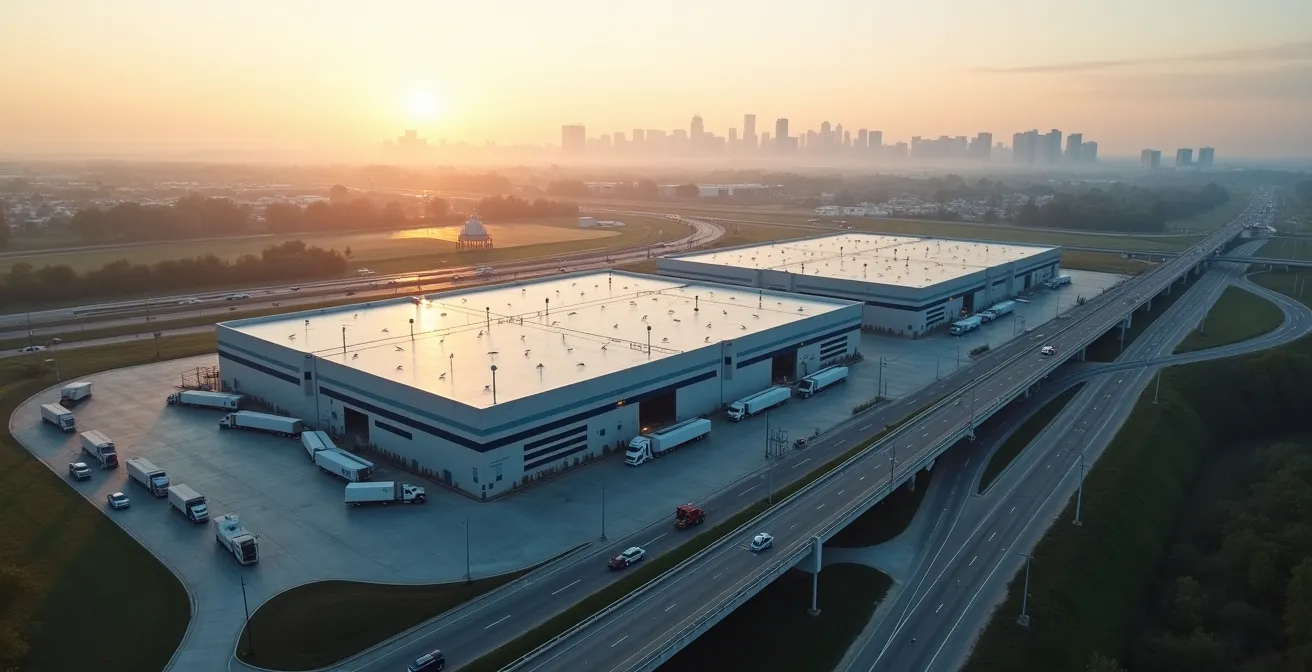
As the illustration above demonstrates, the ideal last-mile facility is defined by its connectivity. Proximity to major highway interchanges, efficient traffic flow for delivery vans, and a location that minimizes drive times into residential areas are the tangible features that justify premium valuations. For tenants, a superior location translates into lower fuel costs, higher driver productivity, and the ability to meet ever-shrinking delivery windows. For landlords, this translates into stickier tenants and stronger rent growth, providing a powerful buffer against recessionary pressures.
How to Identify Which Office Assets Are Obsolete vs. Which Are Value Opportunities?
The office sector is currently a tale of two markets. While headlines focus on soaring vacancies and declining valuations, a “flight to quality” is creating a stark divergence between obsolete assets and genuine value opportunities. Identifying the difference requires looking beyond the vacancy rate and analyzing an asset’s functional and experiential offerings. Obsolete buildings are typically older, Class B or C properties with outdated HVAC systems, poor natural light, and a lack of modern amenities. They are struggling to compete in a world where hybrid work has made the office a destination of choice, not a requirement.
In contrast, value opportunities lie in two distinct categories. The first is top-tier, Class A office space with modern amenities like fitness centers, collaborative lounges, high-end food options, and robust technological infrastructure. Companies are using these premium spaces to entice employees back to the office, and they are willing to pay a premium for environments that foster collaboration and corporate culture. The second opportunity lies in well-located but under-managed Class B buildings that are ripe for a value-add strategy. These are not obsolete structures but rather assets that can be renovated and repositioned with targeted capital improvements to meet modern tenant demands for sustainability (ESG certifications) and wellness.
A key data point from the Green Street CPPI All-Property Index reveals the extent of the damage: while CRE values were down an average of 22%, the office sector led the decline with a staggering 35% drop. This average, however, masks the bifurcation. The buildings driving this decline are the functionally obsolete ones that no amount of rent reduction can save. An investor’s task is to sift through the wreckage to find assets whose “good bones” and prime location make them prime candidates for redevelopment into the kind of modern, experiential workspace that commands premium rents. The risk is high, but the potential to acquire assets at a deep discount and create value is significant.
Data Centers or Cold Storage: Which Niche Sector Has Higher Barriers to Entry?
When comparing niche industrial sectors like data centers and cold storage, investors must understand that their high barriers to entry stem from fundamentally different sources. Both offer attractive, specialized demand profiles, but the challenges in developing them are unique. For data centers, the single greatest barrier is access to massive, reliable power. These facilities are the physical backbone of the digital world, and their power requirements are extraordinary. This creates an enormous hurdle, with one report from CBRE noting that securing adequate power can lead to construction delays of 24 to 72 months in some markets.
This power constraint acts as a natural limiter on new supply, creating a highly favorable environment for existing, well-powered facilities. Furthermore, the high cost and complexity of fitting out a data center mean tenants typically sign long-term leases, providing stable and predictable cash flow for landlords. The technical expertise required to develop and operate these facilities is another significant barrier, excluding all but the most specialized investors and developers.
Cold storage, on the other hand, faces a primary barrier of upfront construction cost. While still power-intensive, the requirements are less extreme than for data centers. However, the cost to build a modern cold storage facility is immense due to the need for specialized insulation, complex refrigeration systems, and higher ceiling clearances. An analysis from NAIOP suggests that cold storage facilities can cost four times as much per square foot as a traditional “dry” warehouse. This immense capital outlay naturally limits the pool of developers who can enter the market. While some markets have fewer zoning restrictions for cold storage compared to the hurdles for data centers, the sheer cost of construction remains the dominant barrier to entry, protecting incumbents from a flood of new competition.
The Single-Tenant Risk That Can Empty Your Building Overnight
While often prized for their simplicity and long-term leases, single-tenant net lease (STNL) properties harbor a significant, concentrated risk: the complete loss of income if that one tenant vacates or defaults. Unlike a multi-tenant property where the loss of one occupant can be absorbed by the others, an STNL asset can go from 100% occupied to 0% occupied overnight. This binary outcome makes tenant credit quality and business resilience the most critical factors in underwriting such an investment, far more so than the property’s physical characteristics.
A recessionary environment amplifies this risk. A tenant that seemed strong during economic expansion may be vulnerable to a cyclical downturn, a shift in consumer behavior, or industry-specific disruption. An investor’s due diligence cannot stop at a glance at the current rent roll; it must extend to a deep, forensic analysis of the tenant’s business health. Is the tenant’s industry defensive or cyclical? What is their market share and competitive positioning? Most importantly, how “mission-critical” is this specific location to their operations? A profitable retail location or a key distribution hub is far less likely to be closed than a redundant office or a marginal store.

Mitigating this concentration risk requires a proactive and disciplined approach to tenant underwriting. Investors must think like credit analysts, not just landlords. This involves evaluating financial statements, understanding industry trends, and assessing the legal strength of the lease, including any parent company guarantees. The following checklist provides a framework for conducting this crucial due diligence.
Action Plan: Tenant Resilience Scorecard
- Evaluate tenant’s credit rating from major agencies (e.g., S&P, Moody’s) to establish a baseline of financial health.
- Analyze the cyclicality and recession-resistance of the tenant’s core business industry.
- Assess the tenant’s market share and competitive position within their specific industry.
- Review the ‘mission-critical’ nature of your specific location to the tenant’s overall operations.
- Examine the tenant’s balance sheet strength, including debt-to-equity ratios and cash flow coverage.
How to Rotate Capital From Retail to Multifamily Before the Market Turns?
Rotating capital from a mature or potentially declining asset class like retail into a growth sector like multifamily is a core strategy for proactive portfolio management. However, timing is everything. Executing this rotation *before* a market turn requires a forward-looking strategy, not a reactive one. A key mechanism for U.S. investors to achieve this tax-efficiently is the 1031 exchange. This provision in the tax code allows an investor to defer capital gains taxes by reinvesting the proceeds from a sold property into a “like-kind” replacement property within a specific timeframe. Advanced strategies even include “reverse exchanges,” where the new multifamily asset is acquired before the old retail property is sold.
The decision to rotate should be driven by asset-level performance and micro-market forecasts, not broad sector headlines. For instance, recent data shows that while multifamily is often seen as more stable, retail vacancy rates actually hit a ten-year low of 4.1% in 2023, slightly better than the 5% vacancy in multifamily. This suggests that a well-located, grocery-anchored retail center may still be a strong performer. The trigger to sell should be a prediction that its growth is plateauing, while the target multifamily market shows stronger prospects for rent growth and appreciation. This requires sophisticated analysis of local demographics, employment trends, and new housing supply.
The ideal rotation strategy involves identifying a retail asset that has reached its peak value, perhaps after a successful value-add business plan has been completed. The investor then markets the property while simultaneously identifying a target multifamily asset in a market with strong fundamentals. By initiating a 1031 exchange, the investor can seamlessly transfer their equity from the stabilized retail property into a new asset with greater upside potential, all while deferring a potentially large tax bill. This preserves capital and allows it to be redeployed for continued growth, which is the essence of strategic portfolio management.
Core vs. Value-Add Assets: What Is the Ideal Ratio for a Stability-Focused Fund?
For an investor focused on stability, determining the right mix of Core and Value-Add assets is a foundational portfolio construction decision. Core assets are the bedrock of stability: high-quality, fully leased properties in prime locations with creditworthy tenants. They generate predictable, bond-like cash flow but offer limited upside. Value-add assets are the engine of growth: properties with operational or physical issues that can be resolved through active management, renovation, or re-leasing, offering higher potential returns but also higher risk. The ideal ratio is not a one-size-fits-all number but a strategic allocation based on an investor’s risk tolerance and the current market cycle.
During periods of economic uncertainty, a stability-focused fund should overweight Core assets. A ratio of 70-80% Core to 20-30% Value-Add is a common defensive posture. This allocation ensures that the majority of the portfolio is generating stable income, providing a cushion against market volatility. The smaller allocation to value-add provides a measured exposure to growth opportunities, allowing the fund to capitalize on mispriced assets without jeopardizing the entire portfolio. This is especially critical in a market where values are correcting; the Green Street CPPI All-Property Index showed year-end 2023 values down an average of 22% from their peak.
Future return expectations also influence this ratio. A forward-looking analysis from CBRE, a leading CRE services firm, provides context for this strategic thinking. As noted in their outlook:
CBRE anticipates capitalization rates widening by another 25 to 50 basis points in 2024 bringing multifamily to around 6%, retail to about 7%, and office to almost 7.5%, on average.
– CBRE Research, Commercial Real Estate Investment Outlook 2024
This anticipated widening of cap rates (a measure of return) implies that property values may continue to decline, reinforcing the case for a defensive, Core-heavy allocation. The value-add component of the portfolio can then be deployed opportunistically to acquire assets at these new, more attractive pricing levels, positioning the fund for outsized returns when the market eventually recovers.
How to Predict Hospitality Revenue Based on Exchange Rate Trends?
Predicting revenue in the hospitality sector is uniquely sensitive to exchange rate fluctuations, as currency values directly impact the purchasing power of international and domestic travelers. A strong local currency makes a country more expensive for foreign visitors, often deterring international tourism, while simultaneously making foreign travel cheaper for locals, encouraging them to vacation abroad. Conversely, a weak local currency acts as a powerful magnet for international tourists, who find the destination more affordable, and encourages “staycations” among locals, who find international travel prohibitively expensive.
However, the impact is not uniform across all hotel types. Investors must analyze the primary customer base of an asset to predict the effect of currency swings. Luxury hotels and high-end resorts that rely heavily on international leisure travelers are most vulnerable to a strong local currency. In contrast, budget and mid-range hotels that cater primarily to domestic business and leisure travelers may be more insulated or could even benefit as locals opt for domestic travel over more expensive foreign trips. Business-focused hotels present a mixed bag, as a strong currency might deter some international corporate travel, but essential business trips are often less price-sensitive.
The following table illustrates how different hotel segments are typically affected by shifts in the local currency’s value, providing a framework for predicting revenue trends. By understanding an asset’s guest mix and its relationship to these dynamics, an investor can better forecast performance and identify risks and opportunities tied to global macroeconomic trends.
| Hotel Type | Strong Local Currency Impact | Weak Local Currency Impact |
|---|---|---|
| Luxury Hotels | Negative – Fewer international tourists | Positive – Attracts foreign visitors |
| Budget/Mid-Range | Positive – More domestic staycations | Mixed – Depends on local demand |
| Business Hotels | Negative – Reduced corporate travel | Positive – More foreign business visitors |
| Resort Properties | Highly negative – Price-sensitive leisure travel | Strong positive – Destination bargains |
Key Takeaways
- Asset-level fundamentals like tenant strength, lease structure, and mission-critical location are more important indicators of recessionary stability than broad sector labels.
- Niche sectors like last-mile logistics and data centers offer high growth potential but require specialized underwriting due to significant barriers to entry related to power, location, and cost.
- A balanced, defensive portfolio blends the stable cash flow of ‘Core’ assets with the opportunistic growth of ‘Value-Add’ plays, using tools like 1031 exchanges for tax-efficient capital rotation.
How to Select Logistics Facilities That Reduce Last-Mile Delivery Costs?
In the world of logistics, the final mile is the most expensive. Therefore, selecting a facility is not just about securing square footage; it’s a strategic decision aimed at directly reducing a tenant’s largest operating expense: transportation. According to one analysis, transportation can account for up to 50% of total supply chain costs. This staggering figure, which includes fuel, vehicle maintenance, and driver wages, underscores why the physical location of a logistics facility is paramount. A building that shaves even a few minutes off delivery routes can translate into millions of dollars in annual savings for a high-volume tenant.
The selection process must prioritize features that facilitate speed and efficiency. This includes immediate access to major arterial roads, avoiding traffic-congested areas, and having a site layout that allows for the efficient flow of delivery vans. Features like a high door-to-square-foot ratio, ample parking for the delivery fleet (not just 18-wheeler trailers), and modern sorting technology all contribute to reducing the “order-to-delivery” cycle time. The impact of these efficiencies is significant, with data showing last-mile cycle times improving from 5.8 days to 3.8 days in just two years, a testament to the ongoing optimization of the network.
Just as the selection of a logistics facility comes down to these micro-details that reduce costs, building a truly recession-resilient CRE portfolio comes down to asset-level specifics that mitigate risk. The overarching theme is clear: stability is not found in broad sector bets but in the granular, operational excellence of individual properties. Whether it’s a logistics center with superior highway access, an office building with sought-after amenities, or a retail center with a creditworthy, necessity-based anchor tenant, the fundamentals of the asset itself will always be the ultimate determinant of its performance in any economic climate.
The next logical step for any investor is to audit their current portfolio against these resilience metrics. By identifying assets with strong fundamentals and those with hidden vulnerabilities, you can begin to formulate a data-driven plan for strategic capital reallocation to ensure your portfolio is built for stability, not speculation.