
The traditional “renovate and raise rent” model for aging commercial assets is broken; the key to maximizing yield now lies in systematically re-engineering the entire asset into a multi-layered revenue platform.
- Value is no longer just in rental income but in monetizing underutilized space (roofs, parking) and mitigating ESG-related “brown discounts.”
- CapEx must be data-driven and tenant-centric, focusing on performance upgrades with clear payback periods rather than costly aesthetic “gold-plating.”
Recommendation: Shift your focus from simple upgrades to a full-scale analysis of your asset’s potential for ancillary income, operational efficiency, and strategic portfolio alignment to build a truly inflation-proof return on investment.
As an asset manager, you’re likely watching your portfolio’s older buildings with growing concern. While they may appear stable on paper, they are quietly bleeding value. In a world of rising inflation and shifting tenant demands, the traditional playbook of cosmetic upgrades and modest rent bumps is no longer sufficient. These assets, once considered “safe,” are becoming liabilities, unable to compete with newer, more efficient, and more desirable properties.
The common advice is to renovate the lobby, add a gym, or refresh the common areas. While not inherently wrong, this approach often misses the bigger picture. It treats the symptom—an aging appearance—without addressing the root disease: an outdated and monolithic business model. This strategy often leads to significant capital expenditure without a guaranteed, or even predictable, return on investment.
But what if the true path to yield maximization wasn’t about making an old building look new, but about fundamentally re-engineering it for the modern economy? The perspective we will explore is that your aging asset is not a single-source income generator but a potential platform for stacked revenue streams. The key is to shift from reactive renovation to proactive value creation, monetizing every square foot and data point to build a resilient, inflation-proof income machine.
This guide provides a new playbook for asset managers. We will dissect why traditional assets are losing value, uncover hidden revenue opportunities, analyze the critical “renovate or sell” decision, and provide frameworks for executing ROI-driven CapEx and strategic portfolio optimization. It’s time to stop patching and start re-engineering.
Summary: A Strategic Playbook for Value-Add Asset Re-engineering
- Why Your “Safe” Assets Are Actually Losing Value Against Inflation?
- How to Generate Non-Rental Revenue From Commercial Parking and Roof Space?
- Renovate or Sell: Which Option Yields a Higher IRR Over a 5-Year Horizon?
- The “Gold-Plating” Mistake That Destroys ROI on Renovations
- When to Push Rents Aggressively: 3 Market Conditions That Support High Increases?
- Why 40% of Your Office Space Is Likely Empty on Tuesdays and Thursdays?
- Why Your Income Statement Is the Best Weapon Against High Assessments?
- How to Execute Portfolio Optimization to Reduce Systemic Risk by 20%?
Why Your “Safe” Assets Are Actually Losing Value Against Inflation?
The concept of a “safe” commercial asset is becoming a dangerous illusion. While your rent roll may seem stable, two powerful and silent forces are eroding your property’s underlying value: inflation and the emerging “brown discount.” Inflation not only increases your operating and capital costs but also devalues future rental income. A 3% annual rent bump means you’re standing still, at best, in a high-inflation environment. Simply put, your asset isn’t appreciating; its purchasing power is declining.
Even more critical is the growing financial penalty for non-compliance with Environmental, Social, and Governance (ESG) standards. This “brown discount” is no longer a theoretical risk; it is a measurable drag on valuation. The market is bifurcating, and investor capital is flowing towards sustainable assets. A recent survey revealed that 41% of investors are targeting net zero by 2030, making ESG performance a core underwriting criterion. Buildings that fail to meet these standards face higher vacancy rates, lower tenant demand, and constrained access to capital.
The consequences of inaction can be severe. Consider New York City’s Local Law 97, which imposes strict carbon emission limits on buildings. The NYC Comptroller’s Office projected that a staggering 70% of buildings could face significant fines by 2030 without major energy retrofits. This is a direct hit to an asset’s Net Operating Income (NOI) and, consequently, its market value. Your “safe” asset isn’t just aging; it’s becoming financially and regulatorily obsolete.
This value leakage requires a proactive strategy, not just to preserve capital but to recapture a competitive edge by aligning the asset with modern market demands for sustainability and efficiency.
How to Generate Non-Rental Revenue From Commercial Parking and Roof Space?
The most significant untapped potential in many aging commercial assets lies in the spaces that generate zero rental income: parking lots and rooftops. It’s time to view these as revenue platforms, not just cost centers. This strategy of “income stacking” involves layering new, non-rental revenue streams onto the existing property, creating a more diversified and resilient cash flow profile that is less dependent on tenant occupancy.
Rooftops, in particular, are prime real estate for community solar projects. Instead of a vacant surface, your roof can become a power-generating asset. By leasing this space to a solar developer, you can create a consistent income stream with minimal capital outlay. According to industry data, typical lease rates for rooftop solar space range from 25 to 85 cents per square foot per year. For a 100,000-square-foot roof, this translates into a significant new source of ancillary revenue.
Parking lots offer a similar opportunity through the installation of solar canopies. These structures provide shade for vehicles—an attractive amenity for tenants—while generating clean energy and revenue. The visual below demonstrates how these canopies transform a simple parking area into a dual-function, value-generating asset.
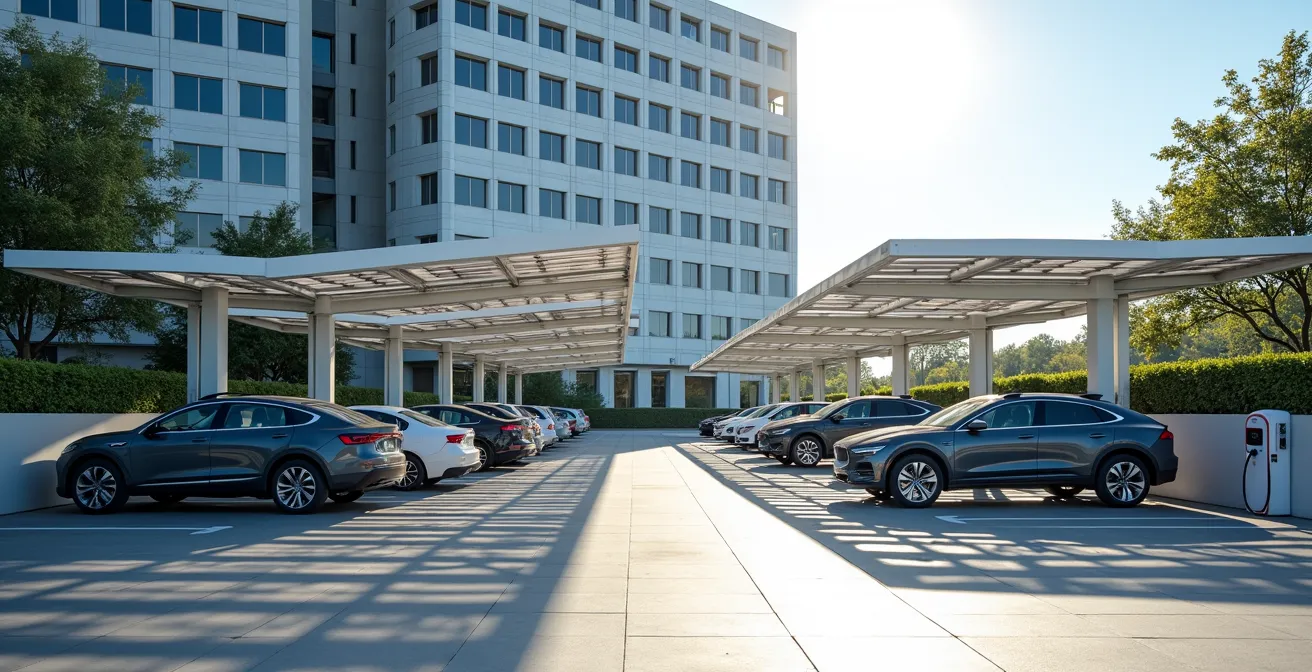
The success of this model is proven. National Storage Affiliates Trust, a real estate investment trust, partnered with a solar developer to install panels across 8.5 million square feet of its facilities. Their executive team noted it was a “great ancillary revenue opportunity” that required minimal investment or effort on their part. This is the essence of asset re-engineering: unlocking value from underutilized and overlooked spaces.
By shifting your perspective, you can transform maintenance liabilities into profitable components of a diversified income strategy, effectively hedging against vacancy and market volatility.
Renovate or Sell: Which Option Yields a Higher IRR Over a 5-Year Horizon?
The “renovate or sell” decision is one of the most critical forks in the road for an asset manager of an aging property. It’s not a gut decision; it’s a financial modeling exercise where the Internal Rate of Return (IRR) is king. The “sell” option provides a clear, immediate capital event. The “renovate” option, however, introduces variables that can dramatically swing the outcome, with the most important being the financing structure of your CapEx plan.
The type of debt you use to fund improvements has a profound impact on your final IRR. Traditional senior debt offers moderate leverage and stable returns, but specialized financing can unlock significantly higher potential. Mezzanine debt increases leverage but comes with higher costs and risk. A particularly compelling option for modernizing aging assets is green financing, such as C-PACE (Commercial Property Assessed Clean Energy), which can fund up to 100% of eligible energy efficiency and renewable energy projects at highly competitive rates.
The following table breaks down how different financing choices influence the financial model, helping you quantify the impact on your projected returns. This analysis demonstrates that the right financing can be as crucial as the renovation itself.
| Financing Type | Typical LTV | Interest Rate Range | Impact on IRR |
|---|---|---|---|
| Traditional Senior Debt | 60-70% | 6-8% | Moderate leverage, stable returns |
| Mezzanine Debt | 75-85% | 10-15% | Higher leverage, increased risk/return |
| Green/C-PACE Financing | Up to 100% | 4-6% | Lower cost, ESG premium capture |
The “renovate” argument is further bolstered by the tangible value created through strategic upgrades. As JLL Research highlights in its 2024 Commercial Property Valuation Study, the market is actively rewarding sustainable improvements. Their analysis provides a powerful data point:
Properties with solar in North America can command a 7% higher premium
– JLL Research, JLL 2024 Commercial Property Valuation Study
Ultimately, a well-structured, smartly financed renovation focused on high-ROI upgrades like ESG compliance and energy generation often outperforms a quick sale, transforming a depreciating asset into a high-yield performer over a 5-year hold period.
The “Gold-Plating” Mistake That Destroys ROI on Renovations
One of the most common and costly errors in managing CapEx for aging assets is “gold-plating”—investing in high-cost, aesthetically pleasing upgrades that have little to no impact on tenant demand or rental income. A marble-clad lobby or designer fixtures might look impressive, but if they don’t solve a tenant’s problem or reduce operational costs, they are a direct drain on your Return on Investment (ROI). True value-add strategy is about surgical, performance-based CapEx, not speculative cosmetic enhancements.
The key is to prioritize investments that deliver measurable returns. This requires a shift in mindset from “what looks good?” to “what performs best?” Often, the highest-impact upgrades are the least visible. For example, data shows that simple operational improvements can cost 20 times less for equivalent energy savings compared to major capital-intensive system replacements. Focusing on optimizing existing systems, improving connectivity, or upgrading security can deliver a much faster payback period than a flashy, but functionally irrelevant, lobby redesign.
To avoid the gold-plating trap, you need a disciplined framework that ties every dollar of CapEx to a specific, measurable outcome. This tenant-centric approach ensures your investments align directly with what drives leasing velocity and tenant retention.
Your Action Plan: The Tenant-Centric CapEx Priority Framework
- Assess Tenant Priorities: Survey existing and prospective tenants to understand what improvements they truly value, such as superior connectivity, HVAC efficiency, or enhanced security systems.
- Calculate Payback Periods: Focus CapEx on upgrades with a sub-3-year payback, achieved through demonstrable rent increases, reduced operating expenses, or lower vacancy rates.
- Test with Pilot Programs: Before a full-scale rollout, implement upgrades on a single floor or wing. Measure the direct impact on leasing velocity and tenant satisfaction to validate the investment.
- Prioritize Performance Over Aesthetics: Allocate capital to high-performance systems like energy-efficient HVAC, smart building controls, and robust digital infrastructure that deliver tangible and lasting ROI.
- Document Value Creation: Meticulously track key metrics post-upgrade, including reduced operational costs, improved tenant retention rates, and achieved lease rate premiums, to prove value to investors and appraisers.
By adopting this data-driven approach, you transform CapEx from a speculative expense into a strategic investment tool, ensuring every renovation dollar actively works to increase your asset’s NOI.
When to Push Rents Aggressively: 3 Market Conditions That Support High Increases?
Pushing rents on an aging asset can be a high-stakes gamble; do it at the wrong time, and you risk a spike in vacancy that negates any potential gains. However, under the right market conditions, aggressive rent increases are not just possible but are the logical outcome of strategic capital investment. The key is to identify and leverage these conditions to your advantage, turning your renovated asset into a price-setter rather than a price-taker.
The first and most powerful condition is a market-wide “flight to quality.” In times of economic uncertainty or shifting work patterns, top-tier tenants consolidate into buildings that offer superior amenities, sustainability, and a premium experience. When your asset becomes one of these desirable destinations through strategic upgrades, you are no longer competing on price with lower-tier buildings. You are competing for a smaller pool of high-value tenants who are willing to pay for quality. This dynamic is what gives you pricing power.

The second condition is the existence of a demonstrable ESG-driven rent premium. As sustainability becomes a core corporate mandate, tenants are increasingly required to occupy certified “green” buildings. This creates a distinct submarket where demand outstrips supply. A comprehensive study by CBRE found that buildings in Europe with certifications like LEED or BREEAM achieved rental prices 21% higher than the market average. When you can provide a certified, energy-efficient space, you can confidently command this premium.
The third condition is a supply-constrained environment for your specific asset class and quality level. If you have successfully re-engineered your asset to a high standard, and there are few comparable options available in your submarket, you are in a dominant negotiating position. This scarcity allows you to push rents to the top of the market, as tenants have limited alternatives that meet their needs for quality, sustainability, and functionality.
When these three conditions align, an aggressive rent strategy isn’t a risk; it’s the logical and profitable culmination of your value-add efforts, allowing you to fully capitalize on your investment.
Why 40% of Your Office Space Is Likely Empty on Tuesdays and Thursdays?
The modern office is a paradox: it’s a critical asset that is often dramatically underutilized. The widespread adoption of hybrid work models means that even with a full tenant roster, a significant portion of your office space can sit empty on any given day. Peak office attendance is now concentrated on mid-week days, leaving Mondays and Fridays quiet. This isn’t just a cultural shift; it’s an economic inefficiency baked into the traditional lease model. Your asset is generating revenue as if it’s 100% utilized, but its functional vacancy is much higher, representing a major untapped opportunity.
Treating this underutilization as a sunk cost is a mistake. The “re-engineering” mindset views this empty space as flexible inventory. Instead of letting it sit idle, you can implement strategies to monetize this “shadow vacancy.” This transforms your building from a static container of long-term leases into a dynamic, hybrid asset that serves multiple needs. The goal is to generate revenue from every square foot, regardless of whether a primary tenant’s employee is sitting there.
Several innovative strategies can achieve this:
- Core + Flex Leasing: Offer tenants smaller, dedicated “core” spaces on long-term leases, supplemented by on-demand access to shared meeting rooms, project spaces, and amenities. This allows tenants to right-size their footprint while giving you a new, high-margin revenue stream from the “flex” space.
- Third-Party Partnerships: Partner with co-working operators, event companies, or even educational institutions to activate underused floors or large common areas. They manage the space and share a percentage of the revenue with you.
- Swing Space Solutions: Package and market blocks of available space as temporary “swing space” for companies in your region that are undergoing their own renovations or need short-term project offices.
- Community Solar Conversion: Even the roof above empty offices can be a revenue source. Converting it to a community solar installation generates lease income that is completely independent of office occupancy rates.
By deploying occupancy sensors to track real usage patterns and identifying these consistently empty zones, you can build a data-driven case for converting them into profitable, alternative uses, making your asset more efficient and profitable.
Why Your Income Statement Is the Best Weapon Against High Assessments?
Property tax assessments are a significant operational expenditure, yet many asset managers fail to use their most powerful tool in an appeal: a meticulously documented income statement that properly accounts for capital expenditures. Assessors often rely on broad market data and standardized valuation models, which may not capture the specific financial realities of your property, especially one requiring significant CapEx. Your income statement, when properly presented, tells the true story of your asset’s profitability.
The critical distinction lies in how Net Operating Income (NOI) is calculated. As a standard accounting principle, CapEx is not deducted when calculating NOI because it’s considered a “below the line” item representing an investment, not an operating expense. A citation from Adventures in CRE clarifies this perfectly: “CapEx does not impact NOI directly because it is recorded below the line.” This is where assessors’ models can be flawed; they may project an NOI based on market rents without factoring in the necessary, non-discretionary capital required to maintain that income stream.
Your argument in a tax appeal is not that CapEx should be deducted from NOI, but that the assessor’s projected income is unsustainable without accounting for the required capital investments. This is where detailed engineering reports and capital budgets become your best evidence.
Case Study: Strategic Use of Engineering Reports in Tax Appeals
Consider the case of a property management firm that faced a high assessment after completing a $750,000 roof replacement. The new roof had a useful life of 25 years. In their tax appeal, they didn’t argue to reduce the NOI. Instead, they used an engineering report to demonstrate that an annual capital reserve of $30,000 ($750,000 / 25 years) was essential to maintain the building’s integrity and ability to command its current rents. They successfully argued that the assessor’s valuation, which ignored this necessary capital outlay, was artificially inflated. This documented future cost provided a compelling, data-backed reason for a lower assessment.
By presenting a clear picture of both your operational income and your necessary capital plan, you can effectively challenge an over-inflated assessment and significantly reduce one of your largest operating costs.
Key Takeaways
- Aging assets lose value not just from physical decay, but from “brown discounts” for ESG non-compliance and inflation eroding rental income.
- True yield maximization comes from “income stacking”—monetizing underutilized spaces like rooftops and parking lots for non-rental revenue.
- Avoid “gold-plating” with purely aesthetic upgrades; focus CapEx on tenant-centric, performance-based improvements with a clear and rapid payback period.
How to Execute Portfolio Optimization to Reduce Systemic Risk by 20%?
After re-engineering individual assets for maximum yield, the final step is to zoom out and optimize the entire portfolio. The goal is to reduce systemic risk—the risk inherent to the entire market—by building a collection of assets that are not all correlated to the same economic cycles. While commercial real estate is inherently a cyclical business, a well-diversified portfolio can smooth out performance and protect against severe downturns in any single sector.
As noted by PineBridge Investments, while commercial real estate may not pose a systemic risk to the broader economy, it is certainly a source of cyclical risk for investors. This insight underscores the need for proactive diversification, not as a defensive measure, but as a core tenet of a value-add strategy. The aim is to create a portfolio that performs reliably across different economic conditions.
Executing this involves several key strategies:
- Tenant Industry Diversification: Map out the industries of your major tenants across the portfolio. If you have heavy concentration in a single sector (e.g., tech or finance), you are highly exposed to a downturn in that industry. The goal is to limit concentration in any one sector to less than 15-20% of your total rent roll.
- Geographic Diversification: Spread your assets across multiple markets with different economic drivers. A portfolio concentrated in one city is vulnerable to local regulatory changes or economic shocks. A presence in several diverse metropolitan areas mitigates this regional volatility.
- Asset Type Mix: This is the most powerful lever. Combine traditional assets like office and retail with counter-cyclical or non-correlated asset types. For instance, logistics and warehouse space often thrive when e-commerce grows, while data centers have shown consistent growth independent of traditional economic cycles. Indeed, some analyses project that data centers will see 7% CAGR revenue growth with low economic correlation.
By systematically applying these diversification principles, you can create a portfolio that is not just a collection of individual properties, but a strategically balanced system designed to weather economic storms and deliver consistent, risk-adjusted returns.