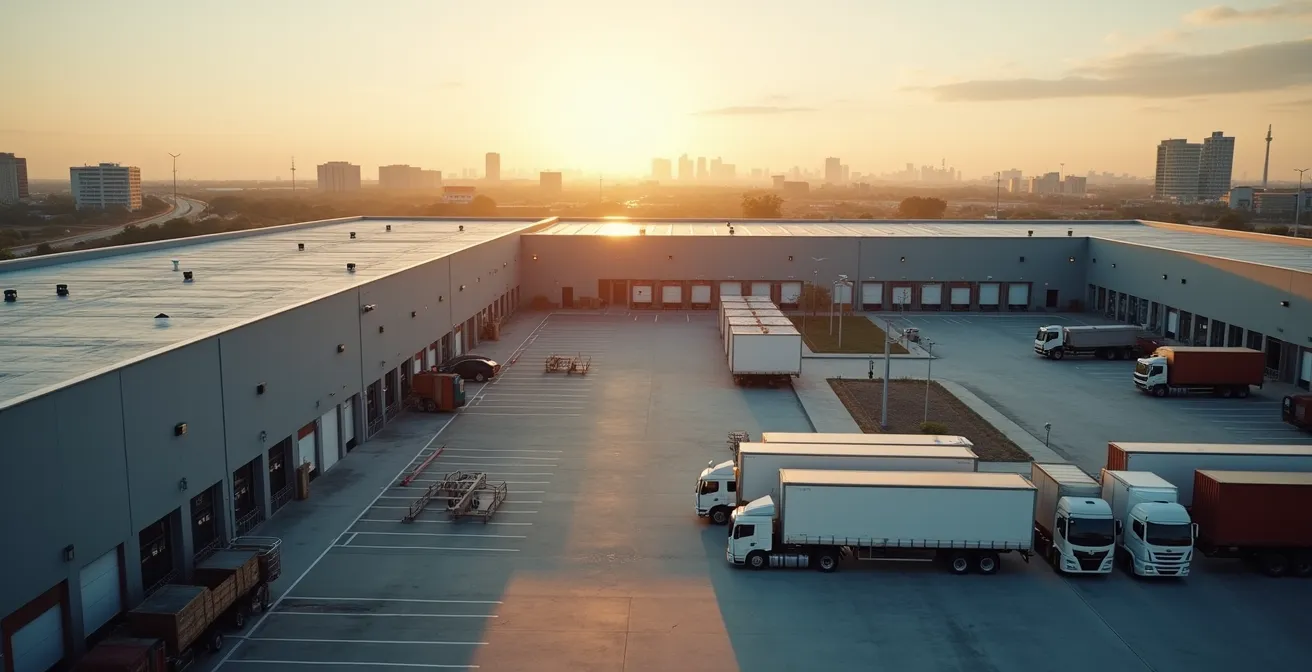
Your biggest lever for reducing last-mile costs isn’t your fleet or software—it’s the building you choose.
- Effective facility selection prioritizes cubic utilization and operational velocity over simple square footage.
- A facility’s “digital infrastructure”—power, connectivity, and floor specifications—is a more critical indicator of future-readiness than its physical size.
Recommendation: Shift from a rent-focused to an operational TCO (Total Cost of Ownership) model for every site selection decision, treating the facility as a strategic asset.
For any Supply Chain Director, the last mile is a battlefield of escalating costs and customer expectations. The conventional wisdom for winning this battle is well-trodden: optimize routes, implement better tracking software, and lease warehouses closer to urban centers. While these strategies are necessary, they are quickly becoming table stakes, yielding diminishing returns in an increasingly complex logistics landscape. The relentless pressure on delivery times and the stark reality that the last-mile operations now account for 53% of total shipping costs demand a more fundamental re-evaluation of our approach.
What if the most powerful, and most overlooked, cost-reduction tool isn’t in your software or your delivery vans, but in the very bones of the buildings you operate from? This is the core of an infrastructure-as-a-strategy approach. It posits that the true potential for savings is unlocked not just by *where* a facility is, but by *what* it is. The decision-making process must evolve beyond a simple calculation of rent per square foot versus distance. It requires a strategic assessment of a facility’s intrinsic characteristics: its vertical capacity, its power grid, its floor flatness, and its dock configuration. These are not mere features; they are the foundational enablers of operational velocity, automation, and labor efficiency.
This guide moves beyond the platitudes of location to provide a strategic framework for evaluating logistics real estate. We will dissect the critical, often-ignored attributes of a warehouse that directly dictate its ability to reduce your last-mile costs. By treating the facility itself as the first and most critical piece of operational machinery, you can build a logistics network that is not just closer to the customer, but fundamentally more efficient, resilient, and profitable.
text
For those interested in how technology is shaping specific logistics verticals, the following video explores a solution for cold-chain management. While our article focuses on the physical facility, this provides a glimpse into the kind of specialized systems modern warehouses must increasingly support.
text
To navigate this strategic evaluation effectively, this article is structured to address the critical questions a Logistics Network Architect must ask. The following sections provide a detailed framework for assessing each key aspect of a potential logistics facility, from its internal specifications to its external market dynamics.
Table of Contents: A Strategic Framework for Facility Selection
- Why Clear Height Matters More Than Square Footage in Modern Warehousing?
- How to Assess if a Facility Is Ready for Robotics and Automation?
- Infill vs. Greenfield: Which Logistics Site Offers Better Labor Availability?
- The Loading Dock Mistake That Creates Bottlenecks for Modern Trucks
- When to Lease Speculative Space: Anticipating Peak Season Requirements
- Why Last-Mile Logistics Properties Are Trading at Premiums Despite the Downturn?
- How to Negotiate Fixed-Price Forward Contracts With Suppliers?
- Rent vs. Buy: How to Decide on Heavy Machinery Strategy for Short-Term Projects?
Why Clear Height Matters More Than Square Footage in Modern Warehousing?
The traditional metric for warehouse capacity, square footage, is an increasingly outdated and misleading indicator of a facility’s true potential. In the age of high-velocity e-commerce, the strategic focus must shift from horizontal sprawl to vertical optimization. The crucial metric is no longer rent per square foot, but total operational cost per pallet position. A facility with a 36-foot clear height can store 50% more product than a 24-foot building with the same footprint, drastically altering the cost-benefit analysis. This verticality allows for denser storage, reducing the need for additional, costly real estate and enabling more efficient inventory management.
This concept of cubic velocity—the speed at which goods move through the total volumetric capacity of a facility—is the new benchmark for last-mile efficiency. Higher ceilings enable the use of advanced vertical racking systems and Very Narrow Aisle (VNA) configurations, which can double or triple storage density. This vertical approach not only maximizes the use of expensive land but also minimizes the travel time for pickers and equipment within the warehouse. By thinking in three dimensions, supply chain directors can unlock significant efficiencies and fundamentally lower the cost structure of their fulfillment operations, proving that height, not just area, is the new competitive advantage.

As the illustration demonstrates, maximizing vertical space is a game-changer. It transforms the warehouse from a simple storage box into a highly organized, high-density fulfillment engine. Evaluating a facility’s clear height is the first step toward building a truly cost-effective last-mile network. To implement this thinking, a structured audit is necessary.
Your Action Plan: Clear Height Optimization Framework
- Calculate true cost per pallet position by factoring in rent, forklift capital costs, and racking system requirements.
- Assess AS/RS compatibility – verify facility height ranges match automation equipment specifications (typically 30-40 feet optimal).
- Map inventory velocity to vertical zones – place A-items at accessible heights, C-items in upper levels.
- Evaluate structural load capacity for high-bay racking systems and mezzanine additions.
- Compare cubic utilization rates across different clear height scenarios for your specific product mix.
How to Assess if a Facility Is Ready for Robotics and Automation?
A facility’s readiness for automation is not determined by its newness or emptiness, but by its underlying infrastructure—a factor many overlook until it’s too late and costly to retrofit. True automation-readiness is a function of a building’s specifications in three key areas: power, floor, and connectivity. An army of Autonomous Mobile Robots (AMRs) is useless if the building lacks the 600+ amp power infrastructure and distributed charging stations to keep them running. Similarly, sophisticated guidance systems for AGVs (Automated Guided Vehicles) require floors with a super-flatness tolerance of ±1mm; a standard floor can derail a multi-million dollar automation project before it even begins.
Therefore, assessing a facility requires an infrastructure-as-a-strategy mindset. You must look beyond the walls and evaluate the digital skeleton of the building. Does it have redundant fiber optic entry points to ensure constant connectivity for your WMS and robotic fleets? Is the layout zoned for safe and efficient human-robot coexistence, or is it a traditional design that will create perpetual bottlenecks? Treating these elements as line items on a “readiness scorecard” transforms the selection process from a real estate transaction into a strategic technology investment. A facility that scores high on this scorecard is not a cost center; it’s a platform that enables future efficiency gains and protects against technological obsolescence.
The following scorecard provides a framework for evaluating the digital and physical infrastructure of a potential site, moving beyond basic needs to what is required for advanced, cost-saving automation.
| Infrastructure Component | Basic Readiness | Advanced Readiness | Impact on ROI |
|---|---|---|---|
| Network Connectivity | Single fiber entry, basic WiFi | Redundant fiber, 5G/LTE capable | 15% operational improvement |
| Floor Specifications | Standard flatness (±3mm) | AGV-ready (±1mm tolerance) | Enables 30% faster AGV deployment |
| Power Infrastructure | Standard 200-amp panels | 600+ amp with charging stations | Supports 50+ autonomous vehicles |
| Zoning Layout | Traditional warehouse zones | Human-robot coexistence design | 25% efficiency gain |
Infill vs. Greenfield: Which Logistics Site Offers Better Labor Availability?
The conventional wisdom is that dense, urban infill sites offer a superior labor pool. However, with labor expenses accounting for 50-60% of total last-mile costs, a more nuanced analysis of “labor gravity” is required. High-density areas often mean intense competition for workers, driving up wages and turnover rates. Furthermore, urban gridlock can make the commute for employees just as challenging as it is for delivery vans, leading to unreliability and absenteeism. The raw number of people in a radius is a poor proxy for a stable, available workforce.
This is where a counter-intuitive strategy can pay dividends. A greenfield site, while further from the urban core, may offer a more significant strategic advantage if it is positioned correctly. The key is to analyze commute-sheds and traffic patterns from the worker’s perspective. A facility located along a reverse-commute path can be a highly attractive option for workers living in suburban or exurban areas, offering them a traffic-free journey to work that is far more reliable than a short but gridlocked trip to an infill site.
As a leading industry analysis points out, this dynamic can fundamentally change the site selection calculus. The Warehouse Site Selection Study 2024 highlights this very point:
A Greenfield site on a reverse-commute path can have a more reliable workforce than a gridlocked infill location
– Logistics Industry Analysis, Warehouse Site Selection Study 2024
Ultimately, the decision requires a sophisticated GIS analysis that models employee travel times during peak shift changes, not just delivery drive times. By prioritizing a stable, accessible workforce over simple proximity to population centers, you can mitigate your largest operational cost and build a more resilient last-mile operation.
The Loading Dock Mistake That Creates Bottlenecks for Modern Trucks
The most common and costly mistake in facility selection is assuming all loading docks are created equal. A warehouse from the 1990s, designed exclusively for 53-foot trailers, will create immediate and persistent bottlenecks for a modern, diversified last-mile fleet. Today’s logistics operations are a multi-modal affair, relying on a mix of large trailers for inbound inventory, and a fleet of sprinter vans, box trucks, and electric delivery vehicles for outbound routes. Each of these vehicle types has unique dock height, apron space, and power requirements. A facility that cannot efficiently accommodate this mix is operationally obsolete.
A strategic approach requires evaluating the dock area as a multi-functional sorting and staging hub. This means looking for a mix of dock heights: standard 48-52 inch docks for trailers, lower 24-36 inch docks for box trucks and delivery vans, and even ground-level drive-in ramps. Furthermore, the rise of electric vehicle fleets introduces a new requirement: adequate power and space for Level 2 or DC fast-charging stations near the dock doors. Companies like Amazon, with their extensive network of specialized transportation hubs, exemplify this strategy by building facilities with mixed-use dock configurations from the ground up to support their diverse Prime Now vehicle fleet.
Choosing a facility with a monolithic, outdated dock design will inevitably lead to costly delays, unsafe loading conditions, and an inability to scale your multi-modal delivery strategy. The table below outlines the specific needs of a modern fleet, providing a clear checklist for your next site assessment.
| Vehicle Type | Dock Height Required | Apron Space Needed | Electrification Needs |
|---|---|---|---|
| 53-foot Trailers | 48-52 inches | 130+ feet depth | Standard power |
| Sprinter Vans | Ground level or 24 inches | 60 feet depth | Level 2 charging |
| Box Trucks | 30-36 inches | 80 feet depth | DC fast charging option |
| Electric Delivery Vans | Variable (24-36 inches) | 60 feet depth | Multiple Level 2 stations |
When to Lease Speculative Space: Anticipating Peak Season Requirements
Leasing speculative, or “spec,” space is often viewed as a pure cost, a reactive measure to handle unexpected overflow. A strategic network architect, however, views it as a calculated financial instrument: buying an “option” on peak season capacity. With consumer expectations ratcheting up—where many during peak seasons, consumers now expect 2-hour delivery—the cost of not having enough capacity is no longer just lost sales; it’s lost customers and brand damage. The decision to lease spec space should not be a panicked reaction in October but a planned, data-driven decision made months in advance.
The analysis involves calculating the “option premium” (the cost of the short-term lease) against the potential downside of stock-outs, delivery delays, and overburdened core facilities during your busiest period. A well-negotiated spec lease, typically for a 3-6 month term over the peak season, acts as an insurance policy. The key is to negotiate flexibility. Clauses for month-to-month extensions, early termination rights, and sublease permissions transform a fixed cost into a variable and manageable operational tool. Moreover, this temporary space can serve as a low-risk sandbox for testing new automation, piloting fulfillment strategies for new markets, or simply acting as a consolidation buffer to improve efficiency at your primary nodes.
By reframing the spec lease from a necessary evil to a strategic option, you can protect service levels, capture all potential revenue during peak, and maintain the sanity of your permanent operations. The following framework outlines how to approach this financial and operational decision.
Your Action Plan: Financial Options Strategy for Speculative Space
- Calculate the ‘option premium’ by comparing short-term lease costs vs potential lost sales during peak.
- Factor in hidden onboarding costs: IT integration, staff training, temporary MHE rentals.
- Evaluate the break-even point: a 15-20% capacity overflow typically justifies spec space.
- Consider multi-use potential: A/B testing for new markets, automation pilots, or as a consolidation buffer.
- Negotiate flexibility clauses: month-to-month extensions, early termination rights, and sublease permissions.
Why Last-Mile Logistics Properties Are Trading at Premiums Despite the Downturn?
In a fluctuating real estate market, it seems counter-intuitive that last-mile logistics properties, particularly in dense urban areas, continue to command premium prices. The reason lies not in conventional market dynamics but in a powerful economic concept: the “Zoning Moat.” This moat is created by the immense difficulty of developing new industrial facilities in or near city centers. A combination of restrictive zoning laws, a scarcity of available land, and strong “Not In My Back Yard” (NIMBY) opposition from local communities makes new construction nearly impossible.
This regulatory barrier creates a state of artificial scarcity. The existing stock of last-mile facilities becomes an irreplaceable asset class. For investors and operators, this means that while the rent may be high, the property holds a durable competitive advantage that is difficult to erode. This is why even during economic downturns, these assets retain their value and trade at premiums. They are not just buildings; they are strategic footholds in high-barrier-to-entry markets. The long-term growth trajectory of e-commerce, with projections that the global last-mile delivery market will reach $318.83 billion by 2032, only reinforces the strategic value of these locations.
A 2024 report on urban logistics properties succinctly captures this reality, explaining the powerful forces at play.
In many dense urban areas, new logistics development is nearly impossible due to NIMBYism, creating a ‘Zoning Moat’ that justifies premium pricing
– Commercial Real Estate Analysis, Urban Logistics Property Report 2024
For a supply chain director, understanding the Zoning Moat is crucial. It justifies paying a premium for a strategic infill location, as the cost is offset by the long-term operational savings and the security of operating from an asset that competitors simply cannot replicate.
Key Takeaways
- Prioritize cubic volume and cost-per-pallet-position over raw square footage when evaluating facility capacity.
- A building’s “digital infrastructure”—power, floor flatness, and connectivity—is a more critical indicator of automation readiness than its age or size.
- Effective labor analysis must model employee commute patterns and reverse-commute advantages, not just population density.
How to Negotiate Fixed-Price Forward Contracts With Suppliers?
In a volatile market, controlling costs is paramount. While many focus on negotiating freight rates, one of the most effective strategies is to lock in the cost of the facility itself through long-term, fixed-price contracts. This is particularly achievable with build-to-suit projects or by securing multi-year leases during favorable market conditions, such as a downturn when landlords are more eager to secure long-term tenants. This strategy moves a significant operational expense from a variable, market-dependent cost to a predictable, fixed line item, providing immense stability for long-range financial planning.
The key to successful negotiation lies in leverage. Before even selecting a site, a savvy director will have researched competitive general contractor markets to understand true construction costs, providing a powerful baseline for build-to-suit negotiations. When leasing, bundling the facility contract with 3PL service agreements can create volume-based discounts that a standalone negotiation would never achieve. Furthermore, the contract details are critical. Insisting on escalation caps that limit annual rent increases to 2-3%, regardless of market fluctuations, is non-negotiable. Another powerful leverage point is to negotiate for the landlord to share in the cost of infrastructure improvements, such as upgrading power or installing super-flat floors for automation. By framing these upgrades as improvements that increase the long-term value of their asset, you can often secure cost-sharing agreements.
By approaching facility acquisition with a long-term, fixed-cost mindset and employing these leverage points, you can hedge against inflation and market volatility, creating a significant and durable cost advantage for your supply chain network.
Rent vs. Buy: How to Decide on Heavy Machinery Strategy for Short-Term Projects?
The decision to rent or buy Material Handling Equipment (MHE) like forklifts and pallet jacks is inextricably linked to your real estate strategy. A short-term lease of 1-3 years almost always dictates a 100% rental strategy for MHE; the capital outlay for purchasing is impossible to justify. Conversely, a 10+ year lease or ownership of a facility makes purchasing MHE a financially attractive option, allowing you to fully depreciate the assets and achieve significant long-term cost savings. The real strategic complexity lies in the 3-7 year lease window, where a hybrid approach is often optimal.
However, the analysis cannot be made in a vacuum. The facility’s location plays a critical role. As noted in recent supply chain research, choosing a facility in a remote location with a non-competitive MHE rental market can be a disastrous mistake. In such a scenario, you lose all flexibility. You are either forced to pay exorbitant rental rates from a single local supplier or make a premature, uneconomical decision to purchase equipment for a medium-term facility. A truly strategic site selection process includes an assessment of the local MHE rental market as a key decision criterion. A location with a healthy, competitive rental market provides invaluable operational flexibility, allowing you to scale your MHE fleet up or down to match demand without being locked into long-term capital commitments.
The following table provides a clear framework for aligning your MHE strategy with your real estate lease term, forming the basis of a total cost of ownership model for any new facility.
| Lease Term | Recommended MHE Strategy | Cost Implications | Flexibility Score |
|---|---|---|---|
| 1-3 Years | 100% Rental | 20-30% higher operating cost | High (9/10) |
| 3-5 Years | Hybrid (60% rental, 40% purchase) | Optimal TCO | Medium (6/10) |
| 5-10 Years | 70% Purchase, 30% rental for peak | 15% cost savings vs rental | Medium (5/10) |
| 10+ Years | 90% Purchase with depreciation | 30% cost savings long-term | Low (3/10) |
Begin transforming your network today by applying this operational Total Cost of Ownership framework to your next facility evaluation and negotiation process.